Unified Traveler Experience Vision
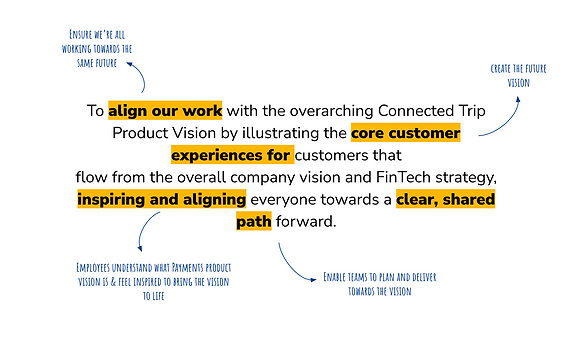
The work aligned everything done with the overarching Connected Trip product vision, turning company strategy into concrete customer experiences so the organization had one clear, shared path forward instead of every team pulling in its own direction. That meant creating an actual future vision (not leaving it implicit), getting teams to understand and feel inspired by it, and making it concrete enough for teams to plan and deliver against.
In practice, that meant serving three audiences: giving Product Leadership an evidence-backed view of Fintech's 3-year ambitions for planning and investment decisions, giving Tech and Data enough experience-level detail to ground their feasibility assessments, and giving the organization a standardized, customer-centric format for vision work so every subdivision could plan against one shared, digestible reference instead of inventing its own.
My Role
I led the vision programme from planning through delivery.
My responsibilities included:
-
defining the programme structure and roadmap
-
facilitating cross-functional design thinking workshops
-
aligning stakeholders across multiple business units
-
synthesising research into strategic opportunities
-
directing the UX vision and storytelling
-
coordinating designers and researchers
-
producing executive presentations for leadership approval
-
ensuring every design decision was grounded in evidence rather than opinion.
Although many designers contributed to the final vision, I was responsible for creating the process that enabled hundreds of ideas to converge into one coherent direction.
Executive Summery
Between 2023 and 2024, I led the creation of Booking.com's three-year Payments Vision, bringing together Product, Design, Engineering, Research and business stakeholders across multiple verticals to define how payments should evolve as part of the Connected Trip strategy. The objective was to establish a shared direction for one of Booking.com's most strategic capabilities.
The work aligned multiple business units around common customer problems, produced a set of customer-centred vision principles, and translated those principles into a tangible future-state experience that could inform product roadmaps and investment decisions.
The Challenge
Payments at Booking.com had grown organically as different travel products matured independently. Accommodation, flights, attractions and other verticals had each evolved their own payment experiences, creating inconsistency for customers and complexity for internal teams.
At the same time, the company's Connected Trip strategy required these experiences to feel increasingly seamless. Customers expected to manage bookings, rewards, loyalty, payments and financial information through one coherent experience, regardless of which travel product they were purchasing.
The organisation needed more than incremental improvements. It needed a shared vision capable of aligning multiple product organisations around a common future.
Designing the Process
Because dozens of teams needed to contribute, the design process became just as important as the artefacts it produced. The programme was structured into several phases:
Phase 1: Define the problem
Aligned stakeholders around strategy, research findings and customer needs while identifying the biggest opportunities across payments.
Phase 2: Create a common understanding
Through collaborative workshops we explored customer pain points, emerging trends
and competitive insights.
Phase 3: Define the future
Working sessions translated research into a set of "Customer Must Be Able To…" statements, creating a customer-centred design framework. Cross-functional design sprints generated concepts, prioritised opportunities and explored future experiences.
Phase 5: Production
The strongest concepts were transformed into high-fidelity prototypes and connected into a single narrative demonstrating how payments could evolve over the next three years.
Phase 5: Production
The strongest concepts were transformed into high-fidelity prototypes and connected into a single narrative demonstrating how payments could evolve over the next three years.
Phase 6: Story telling
The final output became an immersive vision demo that communicated the future customer experience across the organisation.
