Redesigning Payments for Scale
My Role
I led the Payment Component Vision from strategy through experimentation.
My responsibilities included:
-
Defining the programme structure, roadmap and design strategy.
-
Facilitating cross-functional design thinking workshops and ideation sessions.
-
Aligning Product, Engineering, Design and Payments leadership around a shared vision.
-
Synthesising customer research, usability findings and business requirements into strategic design principles.
-
Directing the UX vision, interaction design and storytelling.
-
Coordinating designers, researchers and copywriters throughout the project.
-
Producing executive presentations to secure stakeholder alignment.
-
Ensuring every design decision was supported by research, experimentation or measurable customer evidence.
Although multiple designers contributed to the final solution, I was responsible for creating the process that enabled cross-functional collaboration while maintaining a coherent design direction.
Executive Summery
In 2020, Booking.com embarked on one of its most significant platform transformations: migrating to a new global payments infrastructure that would support the future of the Connected Trip. The migration required replacing both the underlying payment technology and the customer-facing payment experience simultaneously—a high-risk initiative with direct implications for conversion, customer trust, and revenue.
The Payments Migration was a business critical project necessary to enable the future strategy for the entire company. For migration, the business decided to take the risk to both completely change the technical implementation AND the UI of payments at the same time.
I pitched and led the redesign of the payment component to complement the new payment platform in a bid to solve fundamental user and business problems
Recognising that the existing payment component was not designed to scale, I proposed and led the creation of a new Payment Component Vision. Rather than redesigning a single checkout flow, the objective was to establish a flexible, product-agnostic payment system that could be adopted across Booking.com's travel verticals while improving usability and supporting future capabilities such as digital wallets, instalments, credits, vouchers, and new payment timing models.

Objectives
The programme was designed around four strategic objectives:
-
Improve the payment experience while supporting migration to the new payment platform.
-
Design a reusable, product-agnostic payment component that could serve multiple travel verticals.
-
Build a foundation for future payment capabilities, including wallets, vouchers, instalments, credits and flexible payment timing.
-
Balance customer needs, technical constraints and business priorities through an evidence-based design process.
The Challenge
The existing payment experience had evolved over many years and was tightly coupled to legacy technology. As Booking.com expanded beyond accommodation into a broader travel ecosystem, every product had developed slightly different payment experiences, introducing inconsistency for customers and increasing implementation complexity for engineering teams.
At the same time, the company was replacing its payment platform. Rather than migrating the technology alone, the business decided to redesign the customer interface during the migration—significantly increasing delivery risk but creating an opportunity to solve long-standing usability problems.
The challenge was to balance three competing priorities:
-
Stabilise conversion during a business-critical migration.
-
Create a scalable payment component that could be shared across products.
-
Define a long-term UX vision without delaying short-term delivery.
Understanding the Problem
Rather than beginning with interface design, I focused on understanding both customer and organisational challenges.
The discovery phase combined:
-
UX audits across existing payment experiences.
-
Mapping payment flows across products.
-
Industry and competitive analysis.
-
Customer research synthesis.
-
Product feedback.
-
Technical constraints.
-
Cross-functional workshops with Product and Engineering.
This resulted in a shared understanding of where friction existed and established the strategic themes that guided every subsequent design decision.
Key Customer Insights
Several usability patterns consistently emerged across research and testing.
Customers struggled to understand how to select payment methods because payment logos appeared interactive while the actual selection mechanism was hidden behind a secondary dropdown. Many users attempted to tap payment icons directly, creating confusion and unnecessary friction.
Adding a new payment method required navigating multiple levels, increasing cognitive load and abandonment. External payment gateways such as PayPal also introduced uncertainty because transitions between Booking.com and third-party providers lacked clear context.
These findings reinforced that improving payment selection, not simply adding more payment methods, represented the greatest opportunity to improve customer experience.
Designing the Strategy
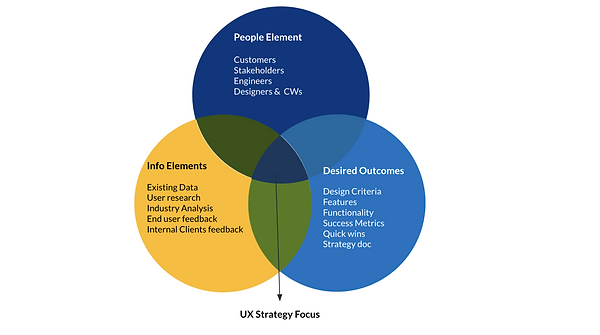
One of the biggest challenges was keeping a technically complex programme understandable for a broad audience.
To achieve this, I created a UX strategy framework that aligned Product, Engineering and Design around three principles:
-
Stay people-first by solving genuine customer problems.
-
Remain data-informed by grounding decisions in evidence.
-
Ensure every initiative directly supported programme objectives.
This framework became a practical communication tool throughout the project, helping diverse stakeholders evaluate ideas against a shared set of priorities rather than personal opinions.
From Vision to Experimentation
Rather than waiting for a complete redesign, I proposed a dual-track approach.
While the team continued developing the long-term vision, we simultaneously identified smaller, high-confidence improvements that could be tested quickly and incorporated into the migration.
This approach allowed us to reduce delivery risk while continuously validating ideas with customers and generating measurable business value.
Outcomes & Impact
The vision extended well beyond interface design.
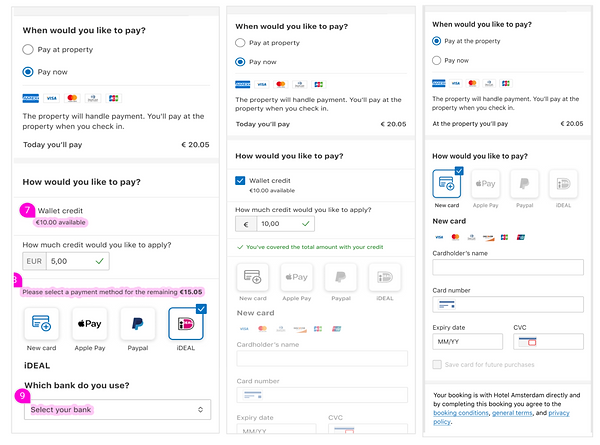
The redesigned payment selection experience increased mobile web conversion by approximately 2%, bringing migration performance back within acceptable business thresholds.
Desktop performance was subsequently improved through iterative experimentation, enabling the new payment experience to be rolled out more broadly.
Beyond conversion improvements, the programme influenced the 2021 Payments roadmap, with multiple concepts from the vision prioritised for implementation and experimentation. The work also introduced a formal UX review process before releases—embedding design quality into the product development lifecycle and reducing production defects caused by inconsistent user experiences.

Leadership Reflection
The most valuable outcome was not a redesigned payment component, it was demonstrating how strategic design leadership can reduce delivery risk while shaping long-term product direction.
By combining research, systems thinking, experimentation and stakeholder alignment, the programme transformed a business-critical migration into an opportunity to establish a scalable design foundation for the future of payments at Booking.com.
The project reinforced a principle that continues to shape my leadership today: the most impactful design leaders don't just create better interfaces, they create the conditions for better decisions.